
Former chief of R&AW C D Sahay dismisses comments linking the Gujarat riots and Babri Masjid demolition to the formation of the Indian Mujahideen
India must watch for signs after Peshawar that Pakistan is waking up to the dangers of Islamism, muses Ajai Shukla
Providing military assistance in the hope that it will change Pakistan's worldview is wrong, says erstwhile ambassador to the United States Husain Haqqani

A grieving Pakistan's policy shift towards the Taliban has comes at a great cost, says Shahzad Raza.
Separatists and their wide network must be neutralized for peace in the Valley

The Pakistani Supreme Court ordered for a joint investigation team to probe the allegations of money laundering against his family.

It would be realistic to see India's position on the DGMOs joint statement more as 'engagement, different from dialogue', where our subsequent options could be decided depending on the realities of the situation on the ground, notes Rana Banerji, who headed the Pakistan desk at the Research and Analysis Wing, India's external intelligence agency.

As the country readies to go to polls on July 25, one can't deny the role of the military, but there are other factors too.

The question really is whether the US can be persuaded to embark on a path of calibrated and stronger sanctions on Pakistan.

'If India is already involved in helping the insurgents in Baluchistan and Karachi, as Pakistan says, it is but one step for New Delhi to bring Dawood or Hafiz Saeed into its sights,' says Amulya Ganguli.

Pakistan's new Army Chief has begun setting the stage to act against groups like LeT and JeM

China will be the nuclear threat of most concern to New Delhi for at least another decade, the latest report by the Arms Control Association says.
We should be prepared for a phase of increased tensions in India-Pakistan relationship thanks to the evolving situation in Afghanistan, says Shyam Saran.
The two countries that will be most affected by the internal developments in Pakistan are India and the United States, says Bob Blackwill. Aziz Haniffa reports

'Since India has to live next to Pakistan, it can't remain under permanent blackmail.' 'A predictable consequence of these fundamental shifts is the fraying of the principle of strategic restraint.' 'It hasn't been junked. But the threshold has been shifted to provide India much greater room for retaliatory action,' says Shekhar Gupta.

The next big destination for IS in South Asia could be India. In India, the SIMI-IM network can provide the logistics for an IS staging area, says Brigadier S K Chatterji (retd).

It would be foolish for Pakistan to assume that India would not act no matter what the provocation is, just because it is militarily more powerful than Myanmar and is armed with nuclear weapons, says Anand Kumar.
'Over the last year, Bajwa has created the environment to support bold moves on India. The ball is in India's court,' a senior Pakistan military officer tells Ajai Shukla.
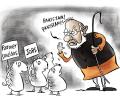
'India serves itself poorly with its latter-day discovery of Pakistan as an instrument in domestic politics,' notes Shekhar Gupta.

The 'surgical strikes' by India have made the army in Pakistan look unprepared. To prove itself the army will need to hit back: It could be in Kashmir or outside
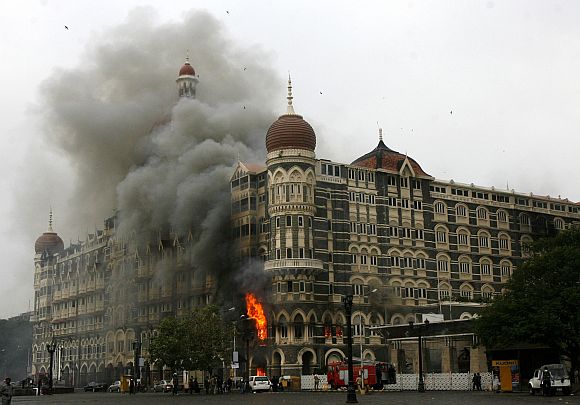
'Headley's testimony indicates to what extent the Pakistan government and its proxies can go to destroy not only Indian scientific talent but also international expertise.'

'By beheading an Indian soldier, the Pakistan army has demonstrated its proclivity for barbaric medievalism.' 'The strategies adopted and the punishment inflicted by India must be made progressively more stringent with every new act of terrorism till the cost becomes prohibitive for Pakistan,' says Brigadier Gurmeet Kanwal (retd).
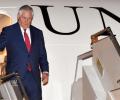
Pakistan Prime Minister Shahid Khaqan Abbasi assured the Secretary of State that his country is committed to the war against terrorism.

'Nawaz Sharif knows a coup in 2016-2017 will not only complete Pakistan's isolation, but even a whiff of instability will frighten the world into imagining another Islamic State-zone, and this in a fully nuclearised subcontinent,' says Shekhar Gupta.

'Kargil was Pakistan's strategic blunder. India must remain on guard against such sinister operations being launched in future by Pakistan's vengeful and devious military leadership that continues to have a hate-India mindset and the mentality of primitive warlords,' says Brigadier Gurmeet Kanwal (retd).

The plan hinged on two critical assumptions: India would not be able to replenish supplies quickly to launch a counter-attack. India could not respond in enough strength to dislodge the Pakistanis. Both assumptions would be proved wrong due to the ferocity of the Indian response, reveals former RAW officer Tilak Devasher in his new book, Pakistan At The Helm.

After weighing all the costs and benefits, the next administration is likely to reduce and restructure assistance to Pakistan but not to end it altogether, says Daniel S Markey.

The jury is still out on whether the Obama-Sharif summit managed to repair the trust deficit and mutual suspicions. But if pleasantries and cordiality was the measure of this summit, it receives a resounding A+ grade, says Aziz Haniffa

'There is need to invent another enemy.' 'If you can add Maoists to Muslims, the tukde-tukde thread will tie in nicely.' 'You might even have a 'nation in grave danger' story by the summer of 2019,' notes Shekhar Gupta.

'The ISI has given a stunning display of its capacity to do with impunity what it likes within Kabul. Incensed over the triumphalism of the hardliners in Kabul, the ISI has hit out; it is a typical ISI reflex action that Indians are familiar with,' says Ambassador M K Bhadrakumar.
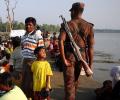
Resettlement of refugees elsewhere is not the morally correct solution to the problem for it lets the perpetrators off the hook.

'Nawaz Sharif asked: "What if I invited him and he declined?"' 'I said I will check.' 'Vajpayee liked the idea. He said I should see him on my return.' Shekhar Gupta reveals how Sharif wanted to make peace, but was tripped by the army and notes the lessons it has for Imran Khan.
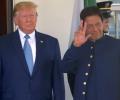
India has not been engaging with Pakistan since an attack on the air force base at Pathankot in January of 2016 by Pakistan-based terrorists, maintaining that talks and terror cannot go together.
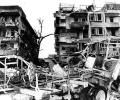
The various theories and statements about the culpability/innocence of 1993 blasts accused Yakub Memon present him with a Rashomon act, says Syed Firdaus Ashraf.
.jpg)
Throughout a quarter century of proxy war, India has shown tremendous restraint in the face of grave provocation. It is inconceivable that any other nation would have refrained from launching trans-LoC operations to eliminate terrorist training camps and interdict known routes of infiltration, says Brigadier Gurmeet Kanwal (retd).

Pakistan, which has propped up the new Taliban leadership, would be keen to use its influence over the group to neutralise India's presence in the region.
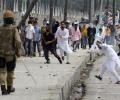
'There is a problem with the rise of a popular view that sees Kashmir through the prism of the larger, chronic Hindu-Muslim tensions.' 'By redefining the Kashmir problem simplistically in Hindu-Muslim terms could end up keeping Kashmir but losing most Kashmiris,' says Shekhar Gupta.

A senior former Obama administration official said if another attack would have happened like that, it would 'quickly escalates into a regional war'.
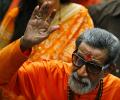
Pakistani-American terrorist David Headley, convicted in the US for his role in the 26/11 Mumbai attacks, on Thursday told a court in Mumbai that terror outfit Lashkar-e-Tayiba wanted to eliminate Bal Thackeray but the person who was assigned the job to kill the late Shiv Sena chief was arrested.
'Three security challenges could emerge shortly. The possibility (almost bordering on certainty) is as certain as the fact that night follows day: A terrorist attack by a Pakistan-based group. Chinese intrusion on the border.Communal tension/riots.' Colonel Anil A Athale (retd) explains what the Modi Sarkar needs to be prepared for.
